 By The UNCHARTED® editors · 5 min read
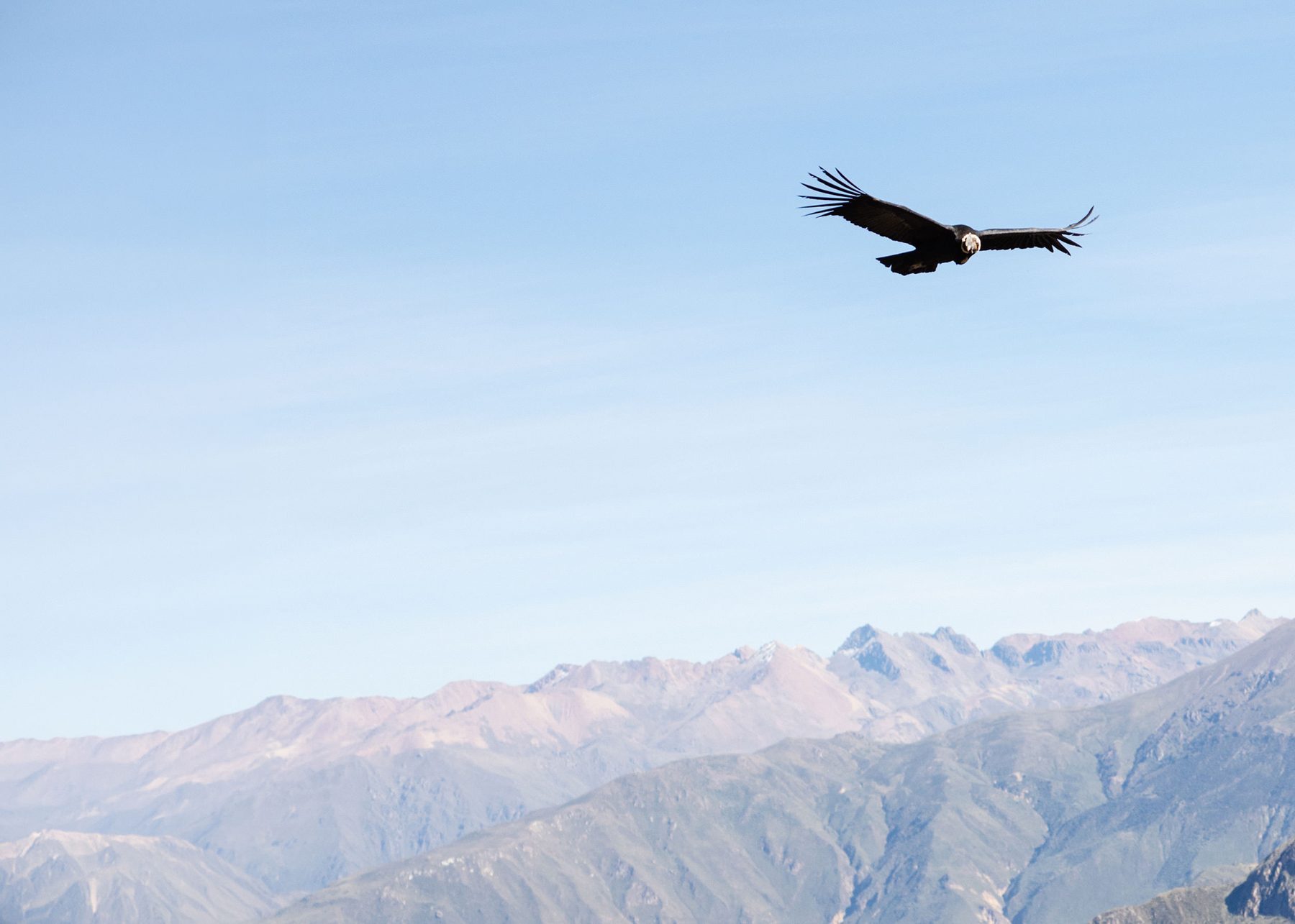
South of well-trodden Machu Picchu and Cusco, the Colca River has spent millions of years carving one of the deepest gorges on earth. It drops 11,000 feet to more than twice the depth of the Grand Canyon, flanked by terraced fields the Collagua and Cabana peoples have farmed since before the Incas arrived. Their descendants still work the same slopes. Condors nest in the canyon walls and lift off every morning on ten-foot wingspans, riding thermals above a landscape most travelers will never see.
WHEN TO GO
April – November
IDEAL FOR
Couples & Explorers
Three hours north of Arequipa, and over a 5,700-foot mountain pass, the Colca Valley is older, stranger, and wilder than anything on a standard Peru itinerary.
GEOGRAPHY
Sitting above the Colca River outside the village of Yanque, Puqio is your way in. Eight canvas tents and adobe rooms overlook a valley where active volcanoes smoke on the horizon, pre-Incan irrigation channels still water the fields, and the canyon drops so sharply into the earth that the river at its floor looks like a green thread from the rim.
High Andean Canyon
TOP EXPERIENCE
Tracking Condors
Puqio is Peru's first safari-style tented camp and the winner of our “Flight of the Condor”
. It’s plain to see why.
2026 Global Safari Award
The Camp:
Eight Rooms of Canvas and Adobe at the Edge of the World
The story starts with a
titled "A Forgotten Valley of Peru." Expedition photographs show canvas tents pitched against canyon walls, a small human outpost in an enormous landscape. Puqio took that image seriously. Opened in 2023, it was built for people who want to be someplace unique and experience its awesomeness, not just see it.
1934 issue of National Geographic
Four Carpa room canvas tents have elevated platforms, private terraces, and outdoor soaking tubs facing the valley; four Pirca rooms are cut into the hillside with in-wall heating, wood-burning stoves, and views that make getting out of bed feel like a decision worth thinking through. Total capacity: 16 guests. The central lodge has open fires, two sitting rooms, and a clay oven producing bread every morning. Meals are served family-style, and everything on the table traces back to gardens and farms within a few miles of where you are sitting. The signature dish is the
, an Incan earth-oven technique unchanged for centuries: potatoes, corn, broad beans, and meat wrapped in mountain herbs and cooked over hot stones underground.
pachamanca
Your Guide:
In the Field with Faure Cruz Tica
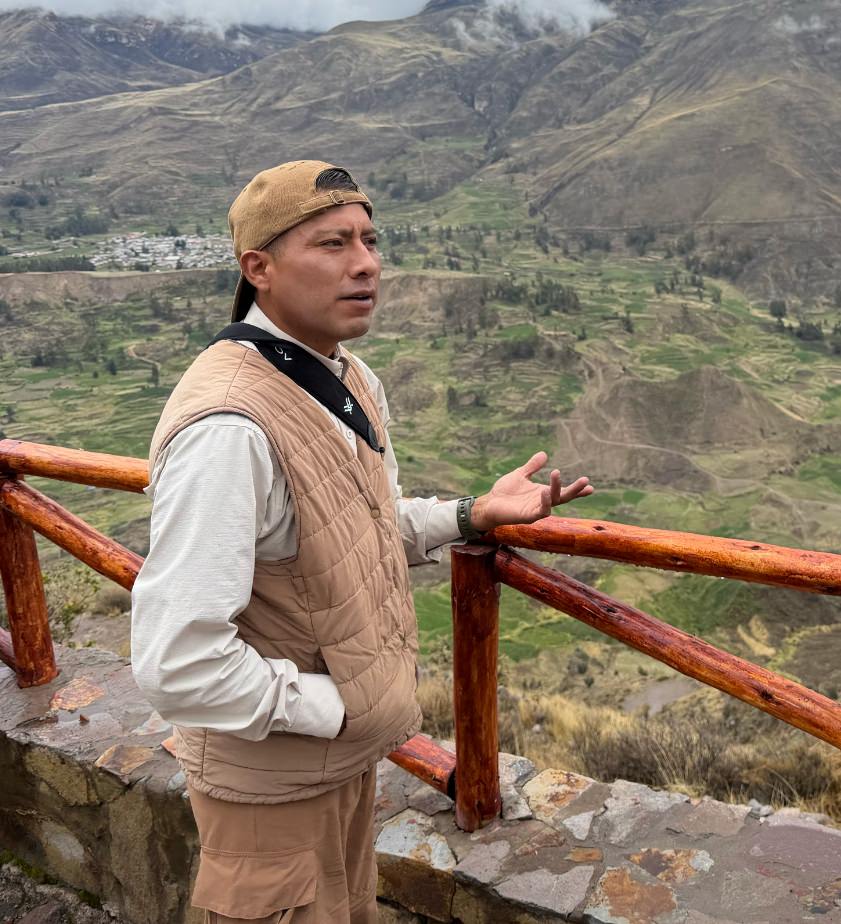
Faure Cruz Tica grew up in Yanque, the village just under a mile from Puqio's gate, and has spent his life learning the canyon the way the Collagua people always have, step by step. He’s the kind of guide who cuts open a Sankayo cactus on the trail when your lungs start to complain about the altitude, hands you the fruit, and keeps walking.
Q: What the Colca has that Machu Picchu doesn't:
“You don't have to focus on which place is more beautiful. You must focus on the difference, because both are completely different.”
Q: What most travelers miss:
“It's not always the condors. I try to show the trail, the views, the geysers. You're walking over 4,400 meters. There are so many places here that aren't touristic but are so beautiful. The Mismi Glacier, where the Amazon River starts. The deepest section of the canyon, where you spend five hours by car just to get there and find no markets, no gas stations, no signal. Nothing.”
Q: What makes the geyser fields so extraordinary:
“The geysers are so beautiful. You have a lot of gases, big pressure out of the sky. It's a place for the condors too — animals who wander there sometimes die, and the condors come to feed. And you have wild cows on the trails, wild horses.”
Q: What makes Puqio different from bigger hotels in the valley:
“The personal attention that all of the staff give to every guest. We have just four tents and four Pircas. Down there they have 50 rooms. Here we spend family time with the guests.”
Q: What to take home:
“The connection. The relationship you start with your environment. You can actually listen to nature here because it's not noisy. The birds, the river, the rain. You're so far from the cities. That's what makes it special.”
The experiences at Puqio run from gentle morning cycles through Yanque and herb-gathering walks along the ravine, to weaving workshops with the master artisans of Chivay, half-day hikes to the Chimpa Fortress, and horseback rides through the canyon at sunset — high in the mountains, with views that are difficult to describe and impossible to forget. For those who want to go further: full-day archaeology routes through the Mollepunku Caves and the stone village of Sibayo, a mule trek to the Alto Pinchollo geysers at 4,400 meters, or a climb toward Mount Mismi, the most remote source of the Amazon River, at over 5,000 meters above sea level.
Condors:
The Incas Called Them Gods
The Inca did not consider the condor a bird in any ordinary sense. It was
Hanan Pacha
, a living messenger between humans and the Upper World. The Colca Canyon hosts a colony of over a hundred of them. They nest in the cliff-face hollows and lift off each morning on wingspans that stretch ten feet across, riding the thermals upward while the canyon drops away below.
Across South America, the condor is in trouble. Habitat loss, historical persecution, and human encroachment have pushed populations toward endangered status. The Colca Canyon remains one of their last great strongholds, and keeping it that way is not accidental. Puqio's model — 16 guests at a time, solar-powered, sourced entirely from local Collagua producers, guided by people who grew up in the valley — is the camp's answer to the question of what responsible access looks like. The canyon has sustained human life for eight thousand years by being treated carefully. Puqio is built on that same logic.