 By The UNCHARTED® editors · 4 min read
From Darwin Onward,
The Evolution of Conservation in the Galapagos
A fascinating conversation with the former Director of the Charles Darwin Foundation about successful marine conservation efforts in the Galápagos Islands.
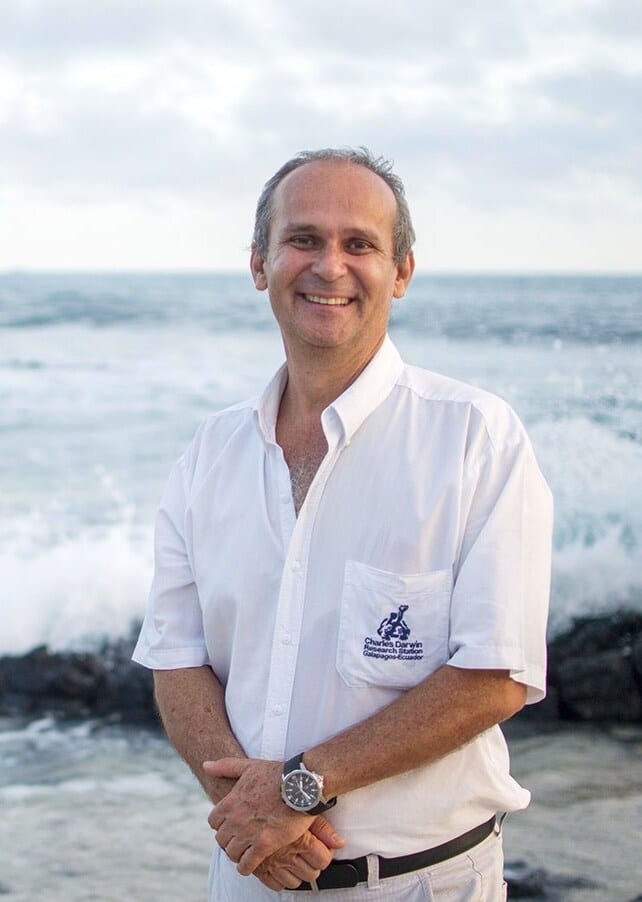
“In the Galapagos, conservation is the culture.”
That’s what stands out about the islands to Arturo Izurieta Valery, currently teaching about “people and parks on islands” as the Tinker Visiting Professor at Stanford University. Unlike many other islands around the world, the Galapagos were largely uninhabited by humans until around 200 years ago, when Darwin’s scientific research set the stage for a culture of reverence for its local wildlife. Today, the archipelago has continued to exemplify how a balance of science and human exploration can create a path toward sustainable conservation.
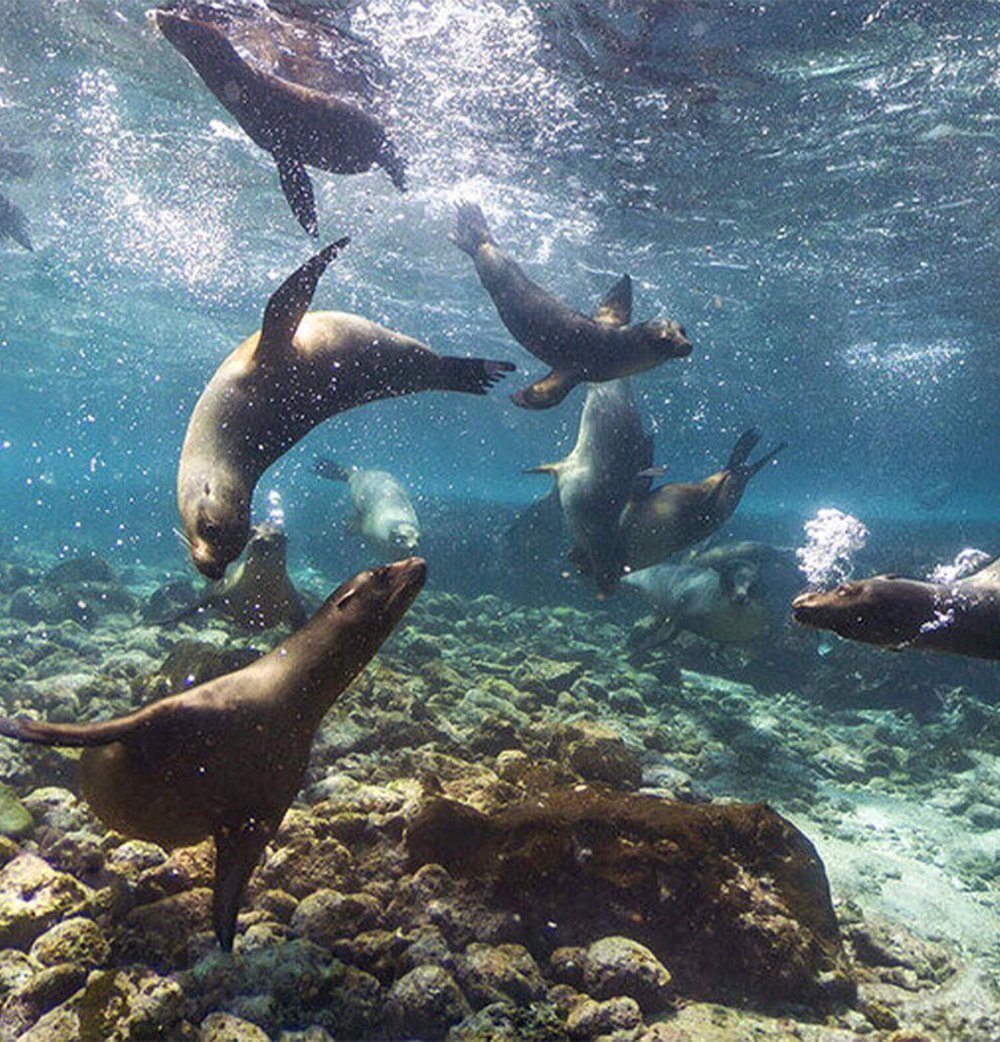
One such path is the dedication of the Hermandad Marine Reserve, which in 2022 expanded the protected area around the Galapagos by 60,000 square kilometers, and includes a migratory pathway north to Cocos Island in Costa Rica. It was a landmark development in conservation because it also had demonstrable benefits for humans: It may seem counterintuitive, but data has shown that expanding the marine protected areas actually results in higher yields for the fishing industry outside the reserve, as local fish populations are enabled to thrive. Tourists, too, can benefit by witnessing the abundant endemic species safely within the reserve.
We spoke further with Arturo about achieving this balance of sustainability, and what role we humans play in preserving the safety of our world’s waters.
Q1: You’ve spent a lot of time in the Galapagos Islands, including a stint as the Executive Director of the Charles Darwin Foundation. Talk to us about your background, what first brought you to the Galapagos, and your experience with conservation efforts there.
Q2: And what kind of sustainability issues are the Galapagos Islands facing now? How does tourism and conservationism play a role on the islands?
You know, one of the differences of the Galapagos compared to many other islands around the world is that it’s never been populated by any permanent human inhabitants, until about 200 years ago. There’s never been a human indigenous population. So the human culture that exists there is a mixture of cultures, and of course the islands became very popular after the visit of Charles Darwin and his book [On the Origin of Species, 1859].
I first went to the Galapagos when I was 20 years old, to work as a naturalist guide. After graduating from universityI worked at the Charles Darwin Research station [on Santa Cruz Island], and taught English at the local school. Finally, I was appointed director of Galapagos National Park, which at that time, included the recently created Marine Resources Reserve. It was only by Presidential decree then [in 1986], and it wouldn’t become a legitimate by-law reserve until 1998.
But Ecuador needs to invest more in science. The entrance fee for tourists does go towards conservation, which does a good job protecting the terrestrial and the marine areas. Having the Hermandad Marine Reserve declared, which happened two years ago, that’s where science comes in as an important tool to understand and provide the basis for decision making. It’s one of the most pristine and well-preserved archipelagos in the world, but people just want to take more and more, and it makes things unsustainable.
I’ve been going back and forth to the islands all my life. I also worked and studied in Costa Rica, and ultimately went to Australia and did my PhD on cross-cultural indicators to assess joint management of national parks. Back in the Galapagos, I eventually had an opportunity to work as the Executive Director of the Charles Darwin Foundation, which runs the Research Station. I was later invited to apply for the Tinker Visiting Professorship at Stanford University, and was accepted, and I’ve been developing tools we’ll be testing this July on the rewilding of the island of Floreana, as well as teaching courses on the sustainability issues that the Galapagos face.
"It’s one of the most pristine and well-preserved archipelagos in the world, but people just want to take more and more, and it makes things unsustainable."
Q3: How can we approach these changes and growth sustainably and set an example for the next generation?
I received a scholarship from the Charles Darwin Foundation, which helped me get my bachelors degree. I don’t where I’d be now if that hadn’t happened. More than 3,000 Ecuadorians have had scholarships and opportunities through the Darwin Foundation, and many of the current higher-ups helped train other professionals who have shaped the future of the islands. So the Galapagos does have a long-term partnership of science and management, which nowadays is extended to the human dimensions and relationships with fishing and tourism.
It is an example of a struggling society in a fragile place, much like the entire planet is now, really—there are more activities, more globalization, technology, more visitors. It’s a learning process, and we’re developing tools on how to manage that, like this upcoming project in Floreana. We’re hoping to eradicate or re-home the rats, mice, and cats [all non-endemic species], and reintroduce tortoises and snakes and repopulate the birds.
But people then want to expand their homes, or build a hotel. They’ll need more access to water [there is not a lot of fresh water on the islands], they’ll create more garbage, use more energy. If you want to grow, you know, you also have to give something, so that things can be shared.